<?xml version="1.0" encoding="utf-8"?>
<feed version="0.3" xmlns="http://purl.org/atom/ns#" xmlns:dc="http://purl.org/dc/elements/1.1/" xml:lang="en">
<title>/var</title>
<link rel="alternate" type="text/html" href="http://www.joewright.org/var/" />
<modified>2008-08-18T17:34:50Z</modified>
<tagline></tagline>
<id>tag:www.joewright.org,2008:/var/1</id>
<generator url="http://www.movabletype.org/" version="3.17">Movable Type</generator>
<copyright>Copyright (c) 2008, Joe</copyright>
<entry>
<title>IT Anniversary</title>
<link rel="alternate" type="text/html" href="http://www.joewright.org/var/archives/2008/08/it_anniversary.html" />
<modified>2008-08-18T17:34:50Z</modified>
<issued>2008-08-18T17:32:18Z</issued>
<id>tag:www.joewright.org,2008:/var/1.103</id>
<created>2008-08-18T17:32:18Z</created>
<summary type="text/plain">On the third Monday in August, 1998 I began my first IT job: first-level support for a bottom of the barrel PC maker whose low-quality computers were sold on a home shopping network. On one hand it seems like a...</summary>
<author>
<name>Joe</name>

<email>jmwright@gmail.com</email>
</author>
<dc:subject>Computer goodness</dc:subject>
<content type="text/html" mode="escaped" xml:lang="en" xml:base="http://www.joewright.org/var/">
<![CDATA[<p>On the third Monday in August, 1998 I began my first IT job: first-level support for a bottom of the barrel PC maker whose low-quality computers were sold on a home shopping network.  On one hand it seems like a long time ago; on the other hand it seems like it was just yesterday.  </p>

<p>I've learned a few things since then.  In no particular order here are 10.</p>

<ul>

<p><li><b>Be realistic</b><br><br />
  You may be able to write cool programs or admin Unix boxes like a pro, you may be the best at what you do, but most people don't care.  Your manager wants you to get projects finished on time and make him look good.  Your coworkers want you to be reliable and personable.  If you're a lazy jerk, it won't matter if you're the best: no one <i>owes</i> you loyalty, friendship or a job.<br><br />
In other words:<br />
</li></p>

<p><li><b>Know thyself</b><br><br />
Know your strengths and use them to help yourself and others.  Know your limitations and either work to overcome them, or at least compensate for them.<br />
</li></p>

<p><li><b>Remember and respect those who help you</b><br><br />
The IT field is full of opportunity, but no one makes it on his own.  You'll meet plenty of people who will help you out: teach you something new, or give you new opportunities, or help you improve yourself.  Be sure to thank them, and show your appreciation by following their example.</li></p>

<p><li><b>Keep your resume updated.</b><br><br />
I'd barely begun my first IT job when I realized that the company probably wasn't going to exist much longer, and I saw that it was a good time to update my resume.  You may not be looking for a new job, but management might be looking for the opportunity to cut costs.  You may not be looking for a new job, but a new job might be looking for someone with your skills.  When you complete a great project, update your resume (to make sure you don't forget to add the project later).  When you master new skills, add them to your resume.</li></p>

<p><li><b>Always learn something new</b><br><br />
Five-year old skills run the risk of becoming irrelevant in IT.  You never know it all.  No matter how much you know, there's always more to learn: new subjects to discover, new depth in the ones you already know.  Always work to make yourself a better programmer, sysadmin, network engineer, whatever you are.<br><br />
Spend some time learning outside the IT field too.<br><br />
Learning other languages is fun and good for your brain.  Pick one that interests you and give it a try.  Learning a little Chinese or Gujarati or Russian (or whatever) won't make you a millionaire or the king of your particular discipline, but someday it'll sure impress your coworkers or your boss or the new contractor at the office, and you never can tell what new opportunities you'll find.<br />
</li></p>

<p><li><b>Keep your eyes open.</b><br><br />
You <i>have</i> noticed that this list contains more than 10 items, haven't you?  Computers are exact; programs are exact; look at that config file or program or data and see what it really says, not what someone else tells you it <i>should</i> say.<br><br />
The IT field is full of opportunity, but it's rarely going to come looking for you.  Keep watch for new opportunities to help, to improve your own job or skills, to make someone else's job easier, to fill a niche.  Keep your eyes open to make sure that your company is doing well; if it isn't, keep your eyes open for new opportunities.</li></p>

<p><li><b>Keep your mouth shut until you have something worthwhile to say.</b><br><br />
Don't talk too much.  Don't ramble.  Don't say things that shouldn't be said.  Before you say something, say it to yourself silently and then decide whether you should say it out loud.  "I'm thinking about it" is a valid answer.  Don't be in such a rush to be the first or loudest to speak; try to be the first to speak <b>correctly</b>.<br />
</li></p>

<p><li><b>Be optimistic</b><br><br />
IT is a field full of opportunity.  You can choose your direction and goals and make them happen.  Your only limitation is your ambition.<br />
</li></p>

<p><li><b>Keep on track: in career, in your speaking, in your writing, in your programming.  Be short and to the point.</b></li></p>

<p><li><b>Get involved</b><br><br />
It's easy for the keyboard and the screen and the server room to become your whole world, and that's actually a fairly lonely world.  Find opportunities to get together with people who share your interests: user group meetings, programming conferences, language classes, and make some friends.  <br></p>

<p>And whether your community is online or in person (or a little of each), pitch in and help out: teach something, train someone, write some documentation, clean up code or clean up a meeting room.<br><br />
Finally, the most important of all:</li></p>

<p><li><b>Have fun.</b></li></p>

</ul>
]]>

</content>
</entry>
<entry>
<title>JLPT 2007 Results</title>
<link rel="alternate" type="text/html" href="http://www.joewright.org/var/archives/2008/02/jlpt_2007_resul.html" />
<modified>2008-02-21T05:32:13Z</modified>
<issued>2008-02-21T05:27:12Z</issued>
<id>tag:www.joewright.org,2008:/var/1.102</id>
<created>2008-02-21T05:27:12Z</created>
<summary type="text/plain">JLPT 2007 results have been out in Japan since last week, but take longer here in the US. I&apos;ve been waiting for the results in the mail. However, since I registered for the test online, today I received an email...</summary>
<author>
<name>Joe</name>

<email>jmwright@gmail.com</email>
</author>
<dc:subject>Japanese</dc:subject>
<content type="text/html" mode="escaped" xml:lang="en" xml:base="http://www.joewright.org/var/">
<![CDATA[<p>JLPT 2007 results have been out in Japan since last week, but take longer here in the US.  I've been waiting for the results in the mail.  However, since I registered for the test online, today I received an email from The Japan Foundation letting me know that I can check the results online.</p>

<p>Writing: 95/100<br />
Listening: 71/100<br />
Grammar/Reading: 157/200<br />
Total: 323/400 (about 80%)</p>

<p>I was pretty confident I'd pass, but it's nice to know for sure.  It'll be nice to get that certificate in the mail, too.</p>]]>

</content>
</entry>
<entry>
<title>JLPT 2007</title>
<link rel="alternate" type="text/html" href="http://www.joewright.org/var/archives/2007/12/jlpt_2007.html" />
<modified>2007-12-11T04:04:51Z</modified>
<issued>2007-12-11T03:49:24Z</issued>
<id>tag:www.joewright.org,2007:/var/1.101</id>
<created>2007-12-11T03:49:24Z</created>
<summary type="text/plain">On December 2 I took the Japanese Proficiency Test in Chicago. I wanted to take level 3, but since I&apos;ve done very little studying this year I signed up for level 4 instead. It was the right choice. Here are...</summary>
<author>
<name>Joe</name>

<email>jmwright@gmail.com</email>
</author>
<dc:subject>Japanese</dc:subject>
<content type="text/html" mode="escaped" xml:lang="en" xml:base="http://www.joewright.org/var/">
<![CDATA[<p>On December 2 I took the Japanese Proficiency Test in Chicago.  I wanted to take level 3, but since I've done very little studying this year I signed up for level 4 instead.  It was the right choice.  Here are some quick thoughts on specific parts of the test, and the JLPT in general.</p>

<p><strong>Writing/vocabulary:</strong> not too tough.  Last-minute cramming actually did some good: while waiting outside the classroom I made a point to remember 帽子をかぶります (which I hadn't really memorized before) and 駅 (which I haven't reached in <i>Remembering the Kanji</i> but is pretty much guaranteed to be on the test.</p>

<p>If I have a complaint about this section of the test, it's that there wasn't enough kanji: after 3 years of Japanese I'm very used to seeing some of them.  Is it possible to reach JLPT 4 level and not know 私?  And I've seen the days of the week so often that it's much quicker to read 火曜日 than 火ようび.  Having to read some of the words in hiragana or kanji/hiragana actually slowed me down.</p>

<p><strong>Listening:</strong> hands-down the toughest for everyone.  Definitely had some unfamiliar vocabulary, and pausing to figure out unfamiliar words meant losing the entire conversation (and the answer to the question).</p>

<p>I've spent the last 1.5 years listening to a lot of Japanese music, audio, etc, and the last month listening to the lv. 3&4 tests from 2005.  Without those I would have done a lot worse.</p>

<p><strong>Grammar/reading:</strong> this part was the most fun.  I liked figuring out the answers and seeing some of the more unusual points of grammar (for this level) like -ながら and (しか + neg vs だけ).  Finished with 20m to spare; reviewed and corrected a few definitely incorrect answers.</p>

<p><strong>General thoughts:</strong><br />
<ul><br />
<li>Good baseline/reality check.<br />
<li>Good experience learning how the test goes.<br />
<li>In my room there were 21 takers (3 no-shows): 18 Americans, 2 Koreans, 1 Chinese.<br />
<li>Partial Heisig/RTK completion is not enough: it's all or nothing.<br />
<li>Last year I completed lesson 14 of <i>Japanese for Everyone</i>; on the JLPT I saw grammar from every lesson.  There might have been some beyond lesson 14 too.  I felt pretty well prepared for level 4 grammar thanks to <i>Japanese for Everyone</i>.<br />
<li>Both in grammar and vocab, (listening too) most material fell into 2 categories: either you knew it or you didn't.  There was a little that could go either way, but not much.<br />
</ul></p>

<p>I'll be surprised if I don't pass this one, and I certainly won't wait until October to start studying for 2008.</p>]]>

</content>
</entry>
<entry>
<title>Japanese is Hard</title>
<link rel="alternate" type="text/html" href="http://www.joewright.org/var/archives/2007/08/japanese_is_har.html" />
<modified>2007-08-25T17:07:31Z</modified>
<issued>2007-08-24T23:17:23Z</issued>
<id>tag:www.joewright.org,2007:/var/1.100</id>
<created>2007-08-24T23:17:23Z</created>
<summary type="text/plain">Well, we survived the move to Wisconsin and are gradually getting settled in. I&apos;m finally (after a 6-month hiatus) beginning to have time to work on Japanese again. Last month marked 3 years, even though halfway through the first lesson...</summary>
<author>
<name>Joe</name>

<email>jmwright@gmail.com</email>
</author>
<dc:subject>Japanese</dc:subject>
<content type="text/html" mode="escaped" xml:lang="en" xml:base="http://www.joewright.org/var/">
<![CDATA[<p>Well, we survived the move to Wisconsin and are gradually getting settled in.  I'm finally (after a 6-month hiatus) beginning to have time to work on Japanese again.  Last month marked 3 years, even though halfway through the first lesson of Pimsleur Japanese in July 2004 I thought to myself, "I won't be doing this for more than 2 weeks." </p>
<p>Yet after 3 years (not counting the last few months) of pretty consistent work (daily textbook study, daily kanji study, daily listening practice, weekly conversation practice, and weekly class time for a while) I think I'm still barely a beginner.  Ouch.</p>
<p>Over at <a href=http://www.alljapaneseallthetime.com>All Japanese All The Time</a> Khatzumoto, in his regular can-do inspirational style, writes that <a href=http://www.despair.com/meetings.html>Japanese is easy</a>, or at least, no more difficult than any other language.  That's the same thing I've been telling people for years.  But after 3 years of Japanese study, I'm changing my tune.  I disagree.  Japanese is hard.</p>
<p>The point of contention, of course, if whether you're looking at it objectively or subjectively.  Objectively you could argue that Japanese is no more difficult than any other language: they're all learned and spoken by humans who all have the same vocal, auditory and mental apparatus.  Babies learn English; babies learn Spanish; babies learn Japanese; and all grow up to speak at a native level.  Well, some more than others.</p>
<p>However, someone learning a second language can't approach it objectively, as a baby, <i>tabula rasa</i>.  A second-language learner already has a base language with years (ok, for some of us it's many, many years) of experience speaking, hearing, absorbing that base language.  And the nature of that base language DOES make some languages more difficult to learn than others.  Objectively Japanese is probably no more difficult than any other language.  For <b>me</b>, someone who's natively spoken English for decades, Japanese is hard.</p>
<p>Of course, English is hard too...for someone who didn't grow up speaking it.  The same is true of Japanese.  It's all a matter of perspective.  Japanese has its own unique and challenging features, but English has many of the same features.  Grammar seems to be a confusing hodgepodge.  Vocabulary is a confusing mix of indigenous words and words borrowed from other languages--sometimes even in the same word.  And let's not even get started on the writing systems--sure, Japanese has kana and all those kanji, but English has English spelling.  Both English and Japanese are complex enough that you simply can't study some grammar, learn to analyze and use a dictionary, and consider yourself an expert--maybe with a simpler, constructed language like Esperanto, but not with English or Japanese.  If you want to speak, listen and read, you just have to learn them and learn them until they become second nature.
<!-- <p>Yet despite the fact that both languages are difficult, Japanese <i>is</i> hard when you're a native English speaker who's learning it as a second (third, fourth, etc) language.  Why?</p> -->
<p>The key difficulty for us English speakers is that Japanese IS so foreign compared to English.  English is a Germanic, Indo-European language.  Japanese is...Japanese.  If you're an English speaker, you'll have a much easier time learning a related language such as German, Spanish, even Russian, Latin, Greek.  Those languages are relatives of English, and share common vocabulary, grammatical structures, thought patterns.  Those similarities and family resemblances make it easier for an English speaker to learn, say, German, than Japanese.  My first year in college I had to take introductory German.  Between late August and late November--3 months--with 5 hours per week of class time, we covered all of German grammar, learned a ton of vocabulary, and were reading basic texts.  After 3 years I was reading medieval theologians in German.  After 3 years of Japanese study...I'm still learning to read and express basic thoughts.  German was a close relative: its vocabulary and grammar were not too difficult to learn, because I already knew related English words and thought patterns, not to mention the writing system.</p>
<p>Japanese is another story.  It has no relation to English, apart from a few borrowed words.  The grammar is foreign, the vocabulary is foreign, the usage is foreign, the thought patterns are foreign--and by "foreign" I mean completely different, not "English with an accent".</p>
<p>Japanese grammar is foreign.  When I started learning, I poked around for a "grammar" in the style of the traditional grammars of European languages.  I wanted to see the familiar mapping of verb tenses and conjugations, the familiar tables of nouns, the usual descriptions of syntax which relate target language structures to familiar ones.  But such a grammar doesn't really exist: the syntax and structures of Japanese just don't map to anything familiar...and it's really best not to try.  It's better to take Japanese grammar as it is than to try to fit it into an alien structure.</p>
<p>Same goes for vocabulary.  There are no comforting familiarities between English and Japanese words.  Once you get beyond "sushi" you're on your own.  Due to the Japanese language's limited phonetic range and plenty of borrowing from Chinese, there are plenty of homonyms.  Words can sound the same but have different meanings; I've heard that people will draw out kanji in the air to clarify exactly which word they're using.  To the untrained ear many different words sound similar, again thanks to the limited phonetic range.  As a result, learning Japanese vocabulary just plain takes more time and effort than, say, Spanish vocabulary.</p>
<p>Look at it this way.  Esperanto again: in the late 1800s a hopeful doctor built the Esperanto language with the thought that a common language might result in better understanding among people and help ease tensions and wars.  What did he build it from?  He used grammar and vocabulary which were familiar to him: Indo-European roots and structures.  The result is a language which is not really transparent to speakers of a single language--you need to study Esperanto--but the amount of study is fairly small.  Speakers of Indo-European languages can look at Esperanto and see many familiar features, many familiar words, and that familiarity makes Esperanto easy to learn.  For a native Japanese speaker with no knowledge of any Indo-European language, however, Esperanto is probably a fairly difficult language to learn.  Familiar grammatical structures?  Nope.  Easy vocabulary?  Nope.  Esperanto is just as foreign as English.</p>
<p>The same is true of English speakers learning Japanese.  Familiar grammatical structures?  Nope, or at least very few.  Easy vocabulary?  A little...but the relatively narrow range of sounds in Japanese means that many words sound quite similar to the untrained ear.  Or at least to mine.  There are very few preinstalled hooks on which to hang Japanese.  In many respects you are starting from scratch, and that makes Japanese more difficult than languages which are at least somehow related to English.</p>
<p>But don't just take my word for it!  Even the US government acknowledges that Japanese is more difficult than many other languages.  The US government's Foreign Service Institute <a href=http://www.nvtc.gov/lotw/months/november/learningExpectations.html>considers Japanese, Chinese and a few others to be "exceptionally difficult for native English speakers"</a>: English speakers need much more study time to reach proficiency in Japanese than in Spanish or Italian.  Japanese's foreignness makes it take much longer to sink into English-programmed brains.  There are no family resemblances, very little related vocabulary.  English speakers have a much longer road to Japanese than they do to Spanish.</p>
<p>So there.  Japanese is hard.  So what?  That difficulty is one of the main reasons I've stuck with it so long, but I'm perverse that way.  However, there might be some value in letting beginners know about the difficulties they face when they start learning Japanese.  It's wise to be realistic when you face a new challenge: how much effort is going to be involved?  how much cost?  do you have the willpower, the motivation, the need to spend that time, effort and money?</p>
<p>In 3 years I've seen a lot of beginners come and go.  Many of them are just plain unrealistic from the start: they expect to "pick up" Japanese in a few hours so they can play video games and watch anime in Japanese.  Others want to be able to talk to their Japanese friends, and some just want a new challenge.  Some spend quite a bit of money before realizing that they're really not THAT interested.</p>
<p>There's no sin in being open about the difficulties a Japanese learner will face.  There's no point in sugarcoating the challenges: beginners will run into them quickly anyway, and if they aren't forewarned they may simply assume they're not smart enough, not good enough to learn Japanese.  To an English speaker, all languages are NOT equally difficult.  Japanese is a much bigger challenge than Spanish.  Why not state the fact up front?  Some will look at the challenge and turn away.  Some will embrace the challenge.  And maybe more will realize that such a challenge will require more than an hour of class time each week.  It requires a new way of thinking, a new method of learning, a stronger immersive approach which will push through the learning barriers and the difficulties with brute force and result in faster, better learning.  A method like All Japanese All The Time.</p>
<p>Or you could simply say that nothing worthwhile is easy, so Japanese is one of the most worthwhile pursuits of all.</p>]]>

</content>
</entry>
<entry>
<title>New job, new adventures</title>
<link rel="alternate" type="text/html" href="http://www.joewright.org/var/archives/2007/06/new_job_new_adv.html" />
<modified>2007-06-01T15:10:24Z</modified>
<issued>2007-06-01T15:08:06Z</issued>
<id>tag:www.joewright.org,2007:/var/1.98</id>
<created>2007-06-01T15:08:06Z</created>
<summary type="text/plain">Time for a new job. Benefits and a living wage are nice--one might even call them a necessity, especially when you have kids. And a decent working environment is always good. It would have been great to have a real...</summary>
<author>
<name>Joe</name>

<email>jmwright@gmail.com</email>
</author>
<dc:subject>Life in general</dc:subject>
<content type="text/html" mode="escaped" xml:lang="en" xml:base="http://www.joewright.org/var/">
<![CDATA[<p>Time for a new job.  Benefits and a living wage are nice--one might even call them a necessity, especially when you have kids.  And a decent working environment is always good.  It would have been great to have a real job in western Michigan but the IT market in western Michigan is, at best, almost dead.  In April I decided it was time to start looking in other areas.  Maybe someplace south, where the winters are less unpleasant.  Indianapolis looked promising.  So did Louisville, Kentucky.</p>

<p>The day before Easter I updated my resume.  The day after Easter I got a call about a great job...in Milwaukee.  Well, Milwaukee isn't south, but it <b>is</b> familiar territory: we lived there from 1991-1995.  So why not give it a try?  A good job in Milwaukee is much better than a rotten job anywhere.</p>

<p>In April I did a bunch of phone interviews, but Milwaukee sounded the best.  They brought me in for a live interview, and offered me the job the next day.  May 21 was my first day. (Why wait so long to mention it?  I wanted to make sure the previous job was going to pay me.)</p>

<p>The job is a great opportunity.  I'm working for a company called <a href=http://www.metavante.com>Metavante</a>, a huge financial data services place.  If you do banking in the US, whether ATM, online or at a branch, chances are good that we handle your data.  I work in the network management group: we make sure the networks that carry your data are working and working well.  I don't know much about networking yet; they brought me in as a Perl programmer to help them maintain and develop tools and automation.  That's exactly the type of work I want to be doing.  The work is fun, the people are great, the company has a future.  It's really nice to be working in this type of environment again.</p>

<p>It's a big change.  We're packing up the house to get it sold.  We moved to western Michigan to be near extended family, but I can't support my own family in Michigan's economy.  I'm going back to an office instead of telecommuting, and living in Milwaukee while everyone else is still in Michigan.  That's not ideal, of course, but we have good prospects of renting a house from a former professor and getting everyone to Milwaukee soon.</p>

<p>So life is busy these days.  I'm at the office a lot, learning all the new things I need to learn, and going back to Michigan on weekends to get the house packed up and ready to sell.  We're really looking forward to finishing this transition and getting back to a normal routine, whatever that is.  But for the first time in a while, things are looking up in work life.<br />
</p>]]>

</content>
</entry>
<entry>
<title></title>
<link rel="alternate" type="text/html" href="http://www.joewright.org/var/archives/2007/04/post.html" />
<modified>2007-07-29T03:38:13Z</modified>
<issued>2007-04-11T19:02:54Z</issued>
<id>tag:www.joewright.org,2007:/var/1.97</id>
<created>2007-04-11T19:02:54Z</created>
<summary type="text/plain">That&apos;s the crickets. It&apos;s been a busy hectic month, and April isn&apos;t going to get any better. But big changes are on the way. I&apos;ll tell you more later....</summary>
<author>
<name>Joe</name>

<email>jmwright@gmail.com</email>
</author>
<dc:subject>Life in general</dc:subject>
<content type="text/html" mode="escaped" xml:lang="en" xml:base="http://www.joewright.org/var/">
<![CDATA[<p>That's the crickets.  It's been a busy hectic month, and April isn't going to get any better.  But big changes are on the way.  I'll tell you more later.</p>]]>

</content>
</entry>
<entry>
<title>Back in print: Mots D&apos;Heures: Gousses, Rames</title>
<link rel="alternate" type="text/html" href="http://www.joewright.org/var/archives/2007/03/back_in_print_m.html" />
<modified>2007-03-09T21:17:56Z</modified>
<issued>2007-03-09T20:58:18Z</issued>
<id>tag:www.joewright.org,2007:/var/1.96</id>
<created>2007-03-09T20:58:18Z</created>
<summary type="text/plain">Way back in September 1986, the beginning of my second year in college, the small town library had a book sale. I don&apos;t know where they got their book donations, but they had the best book sales I&apos;ve ever seen....</summary>
<author>
<name>Joe</name>

<email>jmwright@gmail.com</email>
</author>
<dc:subject>Languages</dc:subject>
<content type="text/html" mode="escaped" xml:lang="en" xml:base="http://www.joewright.org/var/">
<![CDATA[<p>Way back in September 1986, the beginning of my second year in college, the small town library had a book sale.  I don't know where they got their book donations, but they had the best book sales I've ever seen.  They had tons of foreign language books, lots of hardcovers of all sorts.  I got a 1980 Encyclopedia Britannica for $100 and became the envy of many of my friends.</p>

<p>Along with a bag of German and other language books, I picked up a thin little paperback called <a href="http://www.amazon.com/gp/redirect.html?ie=UTF8&location=http%3A%2F%2Fwww.amazon.com%2FdHeures-Gousses-Rhames-dAntin-Rooten%2Fdp%2F0140057307%3Fie%3DUTF8%26s%3Dbooks%26qid%3D1173472997%26sr%3D8-1&tag=joewrightorg-20&linkCode=ur2&camp=1789&creative=9325">Mots D'Heures: Gousses, Rames</a><img src="http://www.assoc-amazon.com/e/ir?t=joewrightorg-20&amp;l=ur2&amp;o=1" width="1" height="1" border="0" alt="" style="border:none !important; margin:0px !important;" />.  It was a strange book.  It consisted of 40 poems in French.  Or did it?</p>

<p>I know almost nothing of French.  I did one or two lessons in a Berlitz Self-Teacher back in '85 or so.  But that was enough.  You don't need to be able to understand French to enjoy <a href="http://www.amazon.com/gp/redirect.html?ie=UTF8&location=http%3A%2F%2Fwww.amazon.com%2FdHeures-Gousses-Rhames-dAntin-Rooten%2Fdp%2F0140057307%3Fie%3DUTF8%26s%3Dbooks%26qid%3D1173472997%26sr%3D8-1&tag=joewrightorg-20&linkCode=ur2&camp=1789&creative=9325">Mots D'Heures: Gousses, Rames</a><img src="http://www.assoc-amazon.com/e/ir?t=joewrightorg-20&amp;l=ur2&amp;o=1" width="1" height="1" border="0" alt="" style="border:none !important; margin:0px !important;" />, you just need to be able to pronounce it.</p>

<p><i>Un petit d'un petit<br />
S'étonne aux Halles<br />
Un petit d'un petit<br />
Ah! degrés te fallent<br />
Indolent qui ne sort cesse<br />
Indolent qui ne se mène<br />
Qu'importe un petit d'un petit<br />
Tout Gai de Reguennes.</i></p>

<p>What does it all mean?  Each poem comes with footnotes to explain unfamiliar words and troublesome phrases...but once you figure out what's going on, you realize that "Luis d'Antin van Rooten", if he really exist(s|ed), was just having a bit of fun.</p>

<p>I have the 1980 Penguin edition of <a href="http://www.amazon.com/gp/redirect.html?ie=UTF8&location=http%3A%2F%2Fwww.amazon.com%2FdHeures-Gousses-Rhames-dAntin-Rooten%2Fdp%2F0140057307%3Fie%3DUTF8%26s%3Dbooks%26qid%3D1173472997%26sr%3D8-1&tag=joewrightorg-20&linkCode=ur2&camp=1789&creative=9325">Mots D'Heures: Gousses, Rames</a><img src="http://www.assoc-amazon.com/e/ir?t=joewrightorg-20&amp;l=ur2&amp;o=1" width="1" height="1" border="0" alt="" style="border:none !important; margin:0px !important;" />.  In 1986 I started a writing a list of poem titles, adding as I figured out each one.  It's been 20 years and I'm still missing 9 titles.  How's <i>that</i> for entertainment value?</p>]]>

</content>
</entry>
<entry>
<title>Myst--what?</title>
<link rel="alternate" type="text/html" href="http://www.joewright.org/var/archives/2007/03/myst--what.html" />
<modified>2007-03-06T02:01:59Z</modified>
<issued>2007-03-06T01:59:09Z</issued>
<id>tag:www.joewright.org,2007:/var/1.95</id>
<created>2007-03-06T01:59:09Z</created>
<summary type="text/plain">So today I got a stock spam email from &quot;Mystekque Mich&quot; with the subject &quot;Joe--message from Mystekque&quot;. How do you pronounce that? To me it looks like &quot;mistake&quot;. How polite of the spammers to warn us against the mistake of...</summary>
<author>
<name>Joe</name>

<email>jmwright@gmail.com</email>
</author>
<dc:subject>Languages</dc:subject>
<content type="text/html" mode="escaped" xml:lang="en" xml:base="http://www.joewright.org/var/">
<![CDATA[<p>So today I got a stock spam email from "Mystekque Mich" with the subject "Joe--message from Mystekque".  How do you pronounce that?  To me it looks like "mistake".  How polite of the spammers to warn us against the mistake of following their stock "advice".</p>

<p>Oh, and it's my birthday today: 29 for the 12th time.  Some people try to tell me it's 40, but I don't know what they're talking about.</p>]]>

</content>
</entry>
<entry>
<title>Unfortunate</title>
<link rel="alternate" type="text/html" href="http://www.joewright.org/var/archives/2007/01/unfortunate.html" />
<modified>2007-01-26T15:59:18Z</modified>
<issued>2007-01-26T15:56:52Z</issued>
<id>tag:www.joewright.org,2007:/var/1.94</id>
<created>2007-01-26T15:56:52Z</created>
<summary type="text/plain">Spotted this on a webpage today. It&apos;s pretty unfortunate considering that it&apos;s an ad for a language school:...</summary>
<author>
<name>Joe</name>

<email>jmwright@gmail.com</email>
</author>
<dc:subject>Languages</dc:subject>
<content type="text/html" mode="escaped" xml:lang="en" xml:base="http://www.joewright.org/var/">
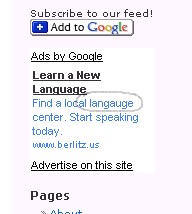
<![CDATA[<p>Spotted this on a webpage today.  It's pretty unfortunate considering that it's an ad for a language school:</p>

<p><img src=http://www.joewright.org/pix/berlitz.jpg></p>]]>

</content>
</entry>
<entry>
<title>The Heisig method as a means, not an end</title>
<link rel="alternate" type="text/html" href="http://www.joewright.org/var/archives/2007/01/the_heisig_meth.html" />
<modified>2007-01-28T01:54:32Z</modified>
<issued>2007-01-26T02:57:28Z</issued>
<id>tag:www.joewright.org,2007:/var/1.93</id>
<created>2007-01-26T02:57:28Z</created>
<summary type="text/plain">When we English speakers teach kids to read, we start by teaching them the entire alphabet at once. Instead of beginning with the letter E and then teaching them a bunch of &apos;E&apos; words, then moving on to T, then...</summary>
<author>
<name>Joe</name>

<email>jmwright@gmail.com</email>
</author>
<dc:subject>Japanese</dc:subject>
<content type="text/html" mode="escaped" xml:lang="en" xml:base="http://www.joewright.org/var/">
<![CDATA[<p>When we English speakers teach kids to read, we start by teaching them the entire alphabet at once.  Instead of beginning with the letter E and then teaching them a bunch of 'E' words, then moving on to T, then A, then O, etc, kids start by learning the alphabet and then learn to read words constructed from that alphabet.</p>

<p>This isn't (or shouldn't be) a time-consuming process: the goal is to teach the alphabet so kids can start using it on real words and real reading as quickly as possible.  They don't learn every aspect of the language when they learn the alphabet; they're learning the infrastructure they need so they can begin.</p>

<p>The Heisig method is similar.  It doesn't create instant kanji experts, nor does it claim to.  Instead, learning the kanji via the Heisig method is akin to learning the alphabet: Heisig learners acquire the ability to recognize and write the kanji, along with a semantic hook for each one.  By simplifying the work (limiting the task to one kanji + one meaning), the kanji "alphabet" can be learned quickly--and should be.  Once this kanji "alphabet" has been learned, the real work of learning readings and compounds begins, and that work should be easier: the learner is already familiar with the kanji and has an approximate meaning, so the rest is often easier to learn.</p>

<p>Heisig's book points out that it's usually quicker for Chinese to learn to read Japanese than for English-speakers.  Why?  Because they're already very familiar with the kanji forms and approximate meanings, so they can move right on to the good stuff.  The Heisig method seeks to provide that same infrastructure for those who don't have that pre-existing kanji familiarity, and to do so quickly.<br />
</p>]]>

</content>
</entry>
<entry>
<title>Halfway through Heisig 1</title>
<link rel="alternate" type="text/html" href="http://www.joewright.org/var/archives/2007/01/halfway_through.html" />
<modified>2007-01-12T19:53:33Z</modified>
<issued>2007-01-12T19:50:12Z</issued>
<id>tag:www.joewright.org,2007:/var/1.92</id>
<created>2007-01-12T19:50:12Z</created>
<summary type="text/plain">Yesterday I reported that I hit the 1000 kanji mark; today I passed the 1021 mark, which is the halfway point in Remembering the Kanji vol. 1. Plus I finished Lesson 27, the longest one in the book (I think)....</summary>
<author>
<name>Joe</name>

<email>jmwright@gmail.com</email>
</author>
<dc:subject>Japanese</dc:subject>
<content type="text/html" mode="escaped" xml:lang="en" xml:base="http://www.joewright.org/var/">
<![CDATA[<p>Yesterday I reported that I hit the 1000 kanji mark; today I passed the 1021 mark, which is the halfway point in <a href=http://www.amazon.com/gp/redirect.html?ie=UTF8&location=http%3A%2F%2Fwww.amazon.com%2FRemembering-Kanji-Complete-Japanese-Characters%2Fdp%2F0870407392%2Fsr%3D8-1%2Fqid%3D1168543759%3Fie%3DUTF8%26s%3Dbooks&tag=joewrightorg-20&linkCode=ur2&camp=1789&creative=9325>Remembering the Kanji vol. 1</a>.  Plus I finished Lesson 27, the longest one in the book (I think).  Heisig says it's downhill from here, but that remains to be seen.  I'd certainly like to keep up the 100 kanji/week pace, but don't know if I'll be able to swing it.</p>]]>

</content>
</entry>
<entry>
<title>1000 Kanji</title>
<link rel="alternate" type="text/html" href="http://www.joewright.org/var/archives/2007/01/1000_kanji.html" />
<modified>2007-01-11T19:37:42Z</modified>
<issued>2007-01-11T19:28:24Z</issued>
<id>tag:www.joewright.org,2007:/var/1.91</id>
<created>2007-01-11T19:28:24Z</created>
<summary type="text/plain">Yesterday I made flashcard 1000 for Remembering the Kanji 1. That&apos;s not quite the halfway point (I&apos;ll reach 1021 tomorrow) but it IS the 1/3 mark for the whole series of 3 books. It&apos;s also a little weird to be...</summary>
<author>
<name>Joe</name>

<email>jmwright@gmail.com</email>
</author>
<dc:subject>Japanese</dc:subject>
<content type="text/html" mode="escaped" xml:lang="en" xml:base="http://www.joewright.org/var/">
<![CDATA[<p>Yesterday I made flashcard 1000 for <a href="http://www.amazon.com/gp/redirect.html?ie=UTF8&location=http%3A%2F%2Fwww.amazon.com%2FRemembering-Kanji-Complete-Japanese-Characters%2Fdp%2F0870407392%2Fsr%3D8-1%2Fqid%3D1168543759%3Fie%3DUTF8%26s%3Dbooks&tag=joewrightorg-20&linkCode=ur2&camp=1789&creative=9325">Remembering the Kanji 1</a><img src="http://www.assoc-amazon.com/e/ir?t=joewrightorg-20&amp;l=ur2&amp;o=1" width="1" height="1" border="0" alt="" style="border:none !important; margin:0px !important;" />.  That's not quite the halfway point (I'll reach 1021 tomorrow) but it IS the 1/3 mark for the whole series of 3 books.  It's also a little weird to be writing 4-digit numbers on my cards now too.</p>

<p>Unfortunately, finances won't allow me to go back to weekly Japanese class for a while.  To compensate, I'm going to pick up the pace in <a href="http://www.amazon.com/gp/redirect.html?ie=UTF8&location=http%3A%2F%2Fwww.amazon.com%2Fexec%2Fobidos%2Fredirect%3Flink%5Fcode%3Dur2%26camp%3D1789%26tag%3Djoewrightorg-20%26creative%3D9325%26path%3Dtg%2Fdetail%2F-%2F0870408534%2Fqid%3D1120055333%2Fsr%3D8-1%3Fv%3Dglance%2526s%3Dbooks%2526n%3D507846&tag=joewrightorg-20&linkCode=ur2&camp=1789&creative=9325">Japanese for Everyone</a><img src="http://www.assoc-amazon.com/e/ir?t=joewrightorg-20&amp;l=ur2&amp;o=1" width="1" height="1" border="0" alt="" style="border:none !important; margin:0px !important;" /> and try to knock off 2 lessons per month instead of 1.</p>

<p>And to observe the passing of kanji 1000, today's mail brought <a href=http://www.thejapanshop.com/product.php?productid=17035&cat=333&page=1>漢字そのままDS楽引辞典 (Kanji Sono Mama DS Rakubiki Jiten)</a>, software which turns your Nintendo DS into a Japanese dictionary which allows you to hand-draw kanji on the touchpad. From the description and the video it looks pretty handy.  Now I just need a Nintendo DS!</p>]]>

</content>
</entry>
<entry>
<title>Language usefulness</title>
<link rel="alternate" type="text/html" href="http://www.joewright.org/var/archives/2007/01/language_useful.html" />
<modified>2007-01-10T15:32:43Z</modified>
<issued>2007-01-10T15:24:06Z</issued>
<id>tag:www.joewright.org,2007:/var/1.90</id>
<created>2007-01-10T15:24:06Z</created>
<summary type="text/plain">Edwin at The Tower of Confusion raises the interesting question of choosing a language based on its usefulness. Often when people try to choose a language based on general &quot;usefulness&quot;, they run the risk of missing the correct answer. I...</summary>
<author>
<name>Joe</name>

<email>jmwright@gmail.com</email>
</author>
<dc:subject>Languages</dc:subject>
<content type="text/html" mode="escaped" xml:lang="en" xml:base="http://www.joewright.org/var/">
<![CDATA[<p>Edwin at <a href=http://towerofconfusion.wordpress.com>The Tower of Confusion</a> raises the interesting question of choosing a language based on its usefulness.  Often when people try to choose a language based on general "usefulness", they run the risk of missing the correct answer.  I don't think that the question is always "What language is most useful?"  I think that a much better question would be, "What language is most useful TO ME?"</p>

<p>Here in the US, people will generally tell you that Spanish is the most useful and important language to learn, because "if you learn another language you can get a better job and make more money."  So I started Spanish in high school and ended up taking it for all 4 years.  I was top of my class and won the school foreign language award.</p>

<p>But in 25 years I've never used Spanish, never have spoken it with a native and probably never could.  Here in western Michigan, what is Spanish useful for?  It's useful if you want to get a job in bilingual customer service or become a social worker for migrants.  Instead, my first career path took me down the path of learning German, Latin, ancient Greek and Hebrew.  In practical and monetary terms, Spanish was useless to me (although it did show me how much fun learning a language could be, and made me actually learn English grammar).</p>

<p>Anyone who wants to learn a language based on its usefulness really needs to consider the "TO ME" aspect of usefulness.  Do you need to learn a specific language for your current job?  Would a particular language help you in a career you want to pursue?  Will a certain language assist you in a hobby or line of research that interests you?  Do you want to learn one language over another simply for the fun of it or out of personal interest?  I think that it's usually better to choose a language based on your specific needs and interests rather than simply choose a language everyone says is most useful and then hope you'll find a use for it.</p>]]>

</content>
</entry>
<entry>
<title>Remembering (Some of) The Kanji 2006</title>
<link rel="alternate" type="text/html" href="http://www.joewright.org/var/archives/2007/01/remembering_som.html" />
<modified>2007-01-05T21:30:25Z</modified>
<issued>2007-01-05T21:13:49Z</issued>
<id>tag:www.joewright.org,2007:/var/1.89</id>
<created>2007-01-05T21:13:49Z</created>
<summary type="text/plain">This year I&apos;m nailing down those 2000 kanji, or 3000 if I have the strength. But first, I wanted to get an idea of where I stand now. During the summer I reached 940 or so before I ran out...</summary>
<author>
<name>Joe</name>

<email>jmwright@gmail.com</email>
</author>
<dc:subject>Japanese</dc:subject>
<content type="text/html" mode="escaped" xml:lang="en" xml:base="http://www.joewright.org/var/">
<![CDATA[<p>This year I'm nailing down those 2000 kanji, or 3000 if I have the strength.  But first, I wanted to get an idea of where I stand now.</p>

<p>During the summer I reached 940 or so before I ran out of steam sometime in July.  I started my 4th comprehensive review in October and reached 950 (the end of lesson 26) just after Christmas.  Now it's new territory again.</p>

<p>Over the last few days I reviewed all 950 kanji and was pleased to remember 93% of them.  I split off a stack of about 125 I need to review and/or relearn, but I think it's time to move on.</p>

<p>I hate to say it, but I have to give up on reviewing with the <a href="http://kanji.koohii.com/">Reviewing the Kanji</a> site.  It's a great site and I like the forums, but the system doesn't really work for me.  I need to have a stack of cards in my hand and judge for myself how well I know them and how/when to review them.</p>

<p>For that matter, the Heisig system itself doesn't work so well for me as-is either.  In the Heisig system you are supposed to visualize an vivid story for each kanji which will stick the kanji in your mind; what works best for me is developing a catchphrase for each kanji and reviewing a lot.  I don't want kanji in my head attached to images, I want to know them without any images or hooks at all.</p>

<p>Or something like that.</p>]]>

</content>
</entry>
<entry>
<title>New Year 2007 Resolutions for Learning Japanese</title>
<link rel="alternate" type="text/html" href="http://www.joewright.org/var/archives/2006/12/new_year_2007_r.html" />
<modified>2006-12-29T22:12:27Z</modified>
<issued>2006-12-29T22:09:30Z</issued>
<id>tag:www.joewright.org,2006:/var/1.88</id>
<created>2006-12-29T22:09:30Z</created>
<summary type="text/plain">I accomplished none of my resolutions for 2006, but made some progress. I&apos;m setting some higher goals for 2007 and think that they&apos;ll be attainable. 1. Complete the textbook &quot;Japanese for Everyone&quot;. If I&apos;m able to continue attending weekly Japanese...</summary>
<author>
<name>Joe</name>

<email>jmwright@gmail.com</email>
</author>
<dc:subject>Japanese</dc:subject>
<content type="text/html" mode="escaped" xml:lang="en" xml:base="http://www.joewright.org/var/">
<![CDATA[<p>I accomplished none of my <a href=http://www.joewright.org/var/archives/2005/12/new_years_resol.html>resolutions for 2006</a>, but made some progress.  I'm setting some higher goals for 2007 and think that they'll be attainable.</p>

<p>1.  Complete the textbook "Japanese for Everyone".  If I'm able to continue attending weekly Japanese class, we will finish the book by the end of 2007.  However, I'd like to pick up the pace and finish it more quickly if I can't attend the class.</p>

<p>2.  2007 is the year I'll finish "Remembering the Kanji" vol 1.  I'm not sure whether I'll use volume 2 for the readings or just start reading.  My goal is to start reading real stuff next year.</p>

<p>3.  Write a mixi diary entry every 1-2 weeks.</p>

<p>4.  Improve listening and conversation.  For the last 2-3 months I've been doing 1-2 hours of conversation practice every week, and plan to continue and maybe add an hour.  Consistent practice with native speakers really works wonders.</p>

<p>5.  Start considering a job where I can use the language.  I started learning Japanese on a whim, just for the challenge.  But it would be fun to use it in real life, I think.</p>]]>

</content>
</entry>

</feed>